The Future of XR Is Already HERE & It’s WILD! (AWE 2025)
My AWE 2025 highlights: the Infinadeck treadmill, new VR locomotion, headsets, display glasses, AR optics, Snap's consumer AR plans and the gaming hub.
 By CasPublished Updated Video + article7 min read
I just got back from AWE 2025, and there’s a lot to talk about. I finally tried a Ready Player One style omnidirectional treadmill, and it felt like stepping into the future. There’s also a new contender in VR movement, some exciting headsets, big steps in AR displays and a gaming hub. These are my personal AWE 2025 highlights: what wowed me and what I think actually matters.
Developer Nation sponsored a part of this video, a short segment about their AR/VR developer survey. They had no say in the rest.
VR movement: treadmills and robotic shoes
Infinadeck
The coolest thing I tried was the Infinadeck, the omnidirectional treadmill straight out of Ready Player One. I’ve wanted to try it forever. You walk naturally in VR, forwards, backwards and even sideways, and as you turn, the floor shifts underneath you to keep you in place. It’s made of moving belts that adjust automatically, so you stay centred without thinking about it.
The demo was short because there was only one prototype at the show, and they capped the speed at 3 miles per hour for safety, though it goes up to 6. I wore three Vive Ultimate Trackers, two on my ankles and one on my back, so no base stations were needed, which is great at an expo and at home. There were a few bugs, which you’d expect at a busy event, but I didn’t care. It felt like real walking, and I picked it up almost instantly.
You can’t get one for home yet. Infinadeck is working on the Infinadeck Portal, a multi-user version for enterprise and military use, launching in 2026. When we filmed, a pre-order meant a $5,000 deposit. It’s early, but this is how new tech usually starts, and after trying it I really hope a home version comes.
XelerateVR ODT 1
The XelerateVR treadmill is aimed at consumers. At first glance it looks like other home options such as KatVR, but instead of a slippery dish it uses thousands of small, freely rotating balls. I tried it at another event, and the movement felt smoother and closer to real walking. It’s not at the Infinadeck’s level, but it’s a fresh concept. You still wear custom shoes that glide over the surface, and it’s meant to be quieter than other slidemills, though not silent.
XelerateVR also focuses on tracking: the system captures detailed foot data for lower latency and more accurate direction control, and it does feel snappy. The current ODT 1 Enterprise costs around $7,000. A consumer version was expected in late 2025 or early 2026 for under $2,000, with a waitlist open.
Freeaim VR shoes
I covered the Freeaim shoes in detail in my AWE 2024 video. To recap, they’re robotic shoes with motorised omnidirectional platforms: tiny wheels under each shoe move you slightly backwards as you step forwards, so you stay in place while it feels like walking, even in a small room.
They were gearing up for a consumer release, with a Kickstarter planned for mid-July 2025 and prices starting around $1,080. At AWE they showed new support options:
- Side bars to hold for balance, which we’ve seen before.
- A more open frame that gives your arms more freedom.
- A full harness, like on VR treadmills. More stable, but it adds resistance when you turn.
It comes down to how much support you want versus how much freedom.
VR headsets and gloves
Play For Dream MR
I finally tried the Play For Dream headset, the first Android-based spatial computing headset. It isn’t Android XR; it runs its own custom Android OS. The specs are serious:
- 8K micro-OLED (4K per eye)
- XR2+ Gen 2 chip
- Tobii eye tracking
- Four-lens pancake optics
- 11 cameras, 7 types of sensors and 22 infrared lights
It’s standalone, but you can stream PC VR too. At the booth I tried some mixed reality demos and a quick round of Half-Life: Alyx through Virtual Desktop. Everything looked sharp and ran smoothly, but I didn’t get to try the spatial computing features, so no verdict yet. I brought one home for a full review.
Shiftall MeganeX Superlight 8K
What stands out here is the size: just 179 grams, with a design inspired by night vision goggles, which I love. Each eye gets a 4K display with 10-bit HDR support, something you rarely see in headsets, plus pancake lenses and a 90Hz refresh rate. It’s one of the most beautiful visuals I’ve seen in VR, and it still feels light.
It isn’t standalone. It uses SteamVR base stations, so it suits people already in that ecosystem. I noticed some warping in the periphery: not major, but there, and I’d need more time to know if I’d get used to it. I first tried a MeganeX at CES 2023, when I wasn’t sure it would ever release. Now it’s out, at $1,899 or €1,899. It’s for a niche crowd who care deeply about visual fidelity, like sim fans.
Shiftall also showed me their FlipVR controllers, which I low-key adore. They flip out of the way so your hands are free for other things, and they make you look cool. They sell separately for $399.
Haptic gloves
A quick update on VR gloves. I tested the Udexreal gloves again: functional, but nothing dramatically new. Reality XR (StretchSense) showed me theirs, but I didn’t get to try them. I’m still unsure about gloves, because content support can be a challenge, but they’re interesting for animators or people mostly in social VR. I’m excited for when they become more consumer friendly, because gloves are far more immersive and accurate than camera-based hand tracking.
It was also nice to see the TouchDIVER gloves again, which let you feel hot and cold. They now cover more of your fingers than when I tried them before. Still enterprise focused, but it’s progress.
Display glasses
VITURE
VITURE has new things coming that I can’t talk about yet. Their current glasses are already solid: Sony micro-OLED with sharp, vibrant visuals, up to 120Hz, 4,000 nits peak brightness and a nice field of view. What really makes them stand out are the accessories. I’ve had their current glasses at home for a while, and the review is coming (sorry for the wait).
My favourite accessory is the dock, which lets you plug in two pairs of glasses to watch or play together. Chary and I played couch co-op Switch games on a flight with it, both with great screens, sitting comfortably upright. That solves a problem we’ve always had with sharing what we see, and it works with other glasses too. I also tried their new model at AWE: an even larger 60-degree field of view with no fringing, and not bulky at all. If you want display glasses for long trips with a partner or friend, these might be the ones to wait for.
XREAL One Pro
XREAL has led this space for a while, and Chary and I always carry their glasses because they’re so reliable. They showed the Ultra 2 again, but the One Pro stood out, the glasses that wowed people on The Tonight Show.
- A virtual screen up to 447 inches with a 57-degree field of view, the biggest I’d seen on released display glasses.
- 3DoF tracking built in for anchoring your screen, with no accessory needed.
- A new accessory that adds 6DoF spatial anchoring, which could open doors for more AR later.
- New NeXus lenses, 11 mm thin, a nice step away from bulky birdbath optics.
- Two frame sizes, software-tuned IPD and Bose audio.
A clean, solid upgrade. I brought a unit home for a full review.
AR optics, Snap Specs and Qualcomm
Lumus and Maradin
On the show floor I saw real progress in brightness and field of view. Lumus had impressive demos: their Z-30 optical engine is smaller, more power efficient and very bright, aiming for up to 7,000 nits per watt, and it’s designed to fit in regular glasses. Brightness matters for reading AR in direct sunlight. The Z-50 raises the field of view to 50 degrees in the same slim format, which we hadn’t seen before.
Maradin has a laser-based scanning display for XR glasses, also 50 degrees, at 720p, in a very compact form factor. Too early to judge, but it looked sharp and promising.
Some companies are already aiming for 70 degrees in glasses, which is getting close to VR headsets but in something you can wear outside. A couple of years ago we were excited about display glasses hitting the 40s.
Snap Specs
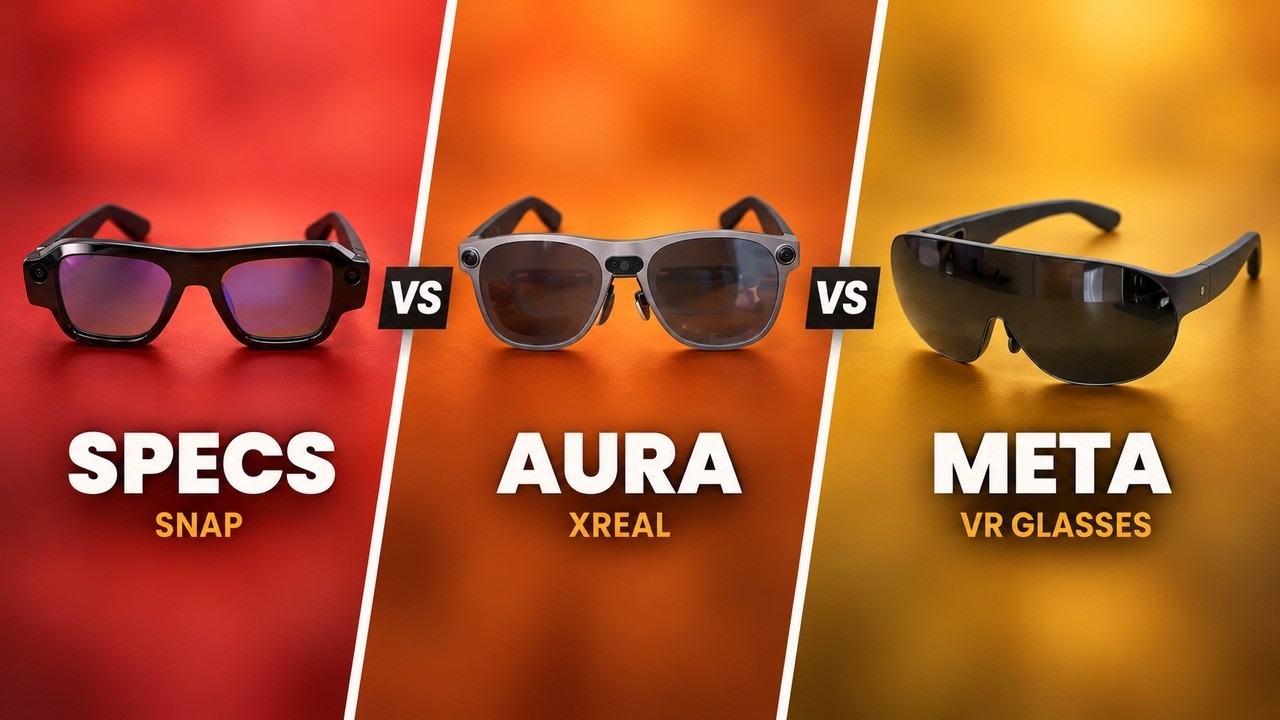
Snap announced real AR glasses for consumers in 2026, not video glasses but actual AR. Their current Spectacles feel like a dev kit version, and at AWE they were everywhere, with a whole floor of demos. I played a multiplayer game shooting arrows at targets with hand gestures against other people, and Chary tried a basketball game. All simple, but polished and a lot of fun.
The upcoming Specs will have full 6DoF tracking too, so you can place 3D objects, walk around them and interact with your hands. Snap promises they’ll be lighter and more immersive, with more AI. I hope the field of view and battery life improve as well. What excites me is the ecosystem: 400,000 Lens creators already, and partnerships with Niantic, OpenAI and Google. So full AR Pokémon Go might not be such a wild idea. Developer support will make or break it, as with any hardware.
Qualcomm Snapdragon’s AR demos
Qualcomm’s booth was mostly AR this year:
- RayNeo’s new AR glasses are binocular, with displays in both eyes, and much smaller than earlier versions. In an AI fitness demo I asked what workout suits my age and got a full guided video on the spot. I might review these soon.
- The KDDI x Capcom Monster Hunter headset is a custom AR headset from Snapdragon, KDDI and Capcom for a Monster Hunter experience, with a 105-degree diagonal field of view, infrared 6DoF tracking and up to 20 people in one AR space. I tried a demo version where I petted a Palico (so cute) and almost got roasted by a dragon. This belongs in theme parks or museums, but the shared spatial interaction at that scale is impressive.
- The KiWear smart ring controls XR glasses with finger gestures. Small, works well, and far less tiring than waving your arms. I’d love it as an add-on.
Distance AR windshield
Not a wearable, but big for anyone who drives. Distance showed what it calls the world’s first glasses-free AR windshield, which turns the whole windshield into a 3D see-through display. It uses eye tracking and light field technology to place depth-accurate visuals where you’re looking. It isn’t bright enough for full outdoor use yet, but it felt like the future of driving: navigation, traffic and obstacle alerts layered into your actual view. The team are former Varjo people, and Google Ventures backed them with $11 million. You won’t buy this soon, but it already works, and it could end up in helmets, snowboard goggles or AR glasses.
The first AWE gaming hub
This was the first year AWE had a dedicated gaming hub, and it’s about time. The games that caught my eye:
- Elsewhere Electric was one of my favourites, a co-op game where one player is in VR and the other on a phone. Great asymmetric gameplay, and I love the art style.
- Jigsaw Night is a calm, cozy puzzle game from ex-Qualcomm folks that you solve together with a friend. Just chill.
- Trip the Light is an immersive rhythm dance game where you dance hand in hand with an AI partner who teaches you moves in real time. It feels like a new genre.
- Tower of Titans uses hand tracking to let you sling magic, and I’m always into spellcasting. The wave-based demo felt a bit repetitive, but they told me the full game won’t be like that.
- Vivarium is a cozy, relaxing, visually soothing mixed reality game to wind down with at the end of the day.
My takeaway from these AWE 2025 highlights
I tried much more than I could fit in, so these are the things that stood out. The common thread: walking in VR finally feels natural, display glasses are getting brighter, wider and smaller, and real consumer AR glasses are on the way. Seeing how close all of this is to science fiction, the next few years are going to be wild.