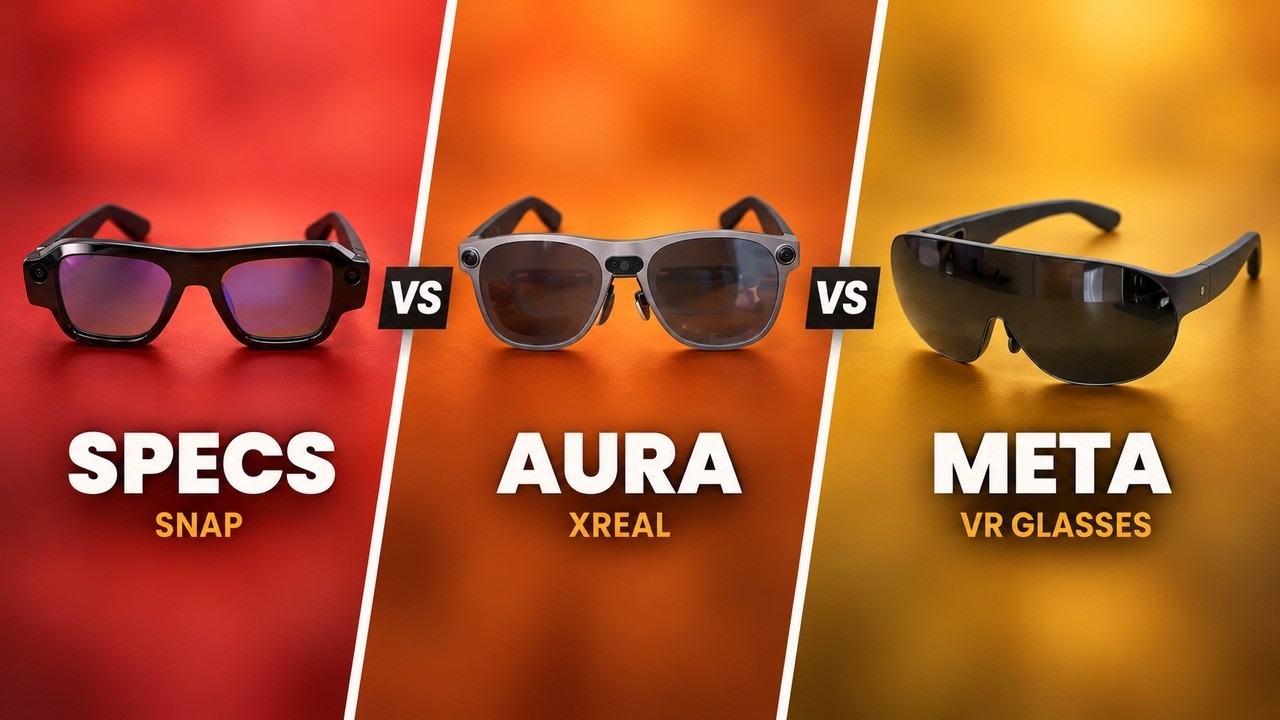
I TRIED The Future Of VR/AR & It’s WILD (AWE 2026)
Snap SPECS, XREAL AURA, Snapdragon Reality Elite, a 93-gram VR headset, 70° waveguides and two rings: everything worth knowing from AWE 2026.
 By CasPublished Updated Video + article10 min read
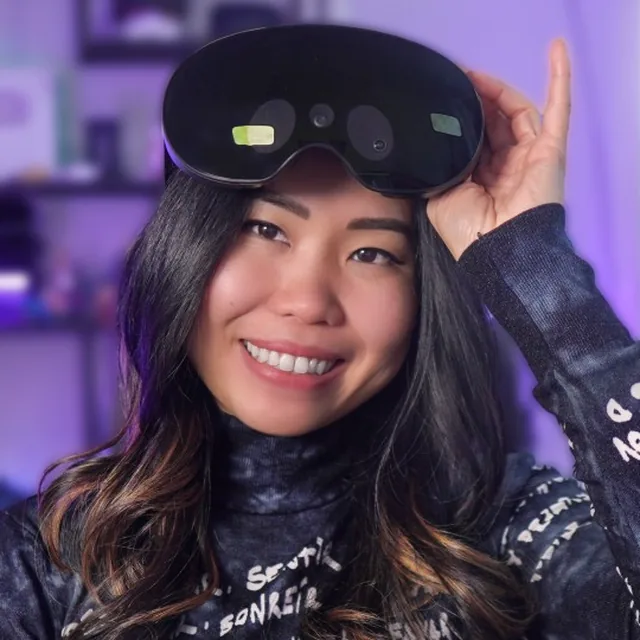
This is a VR headset. No, really, this tiny thing. How small it is might be the most important thing I saw at the whole show, because one of VR’s biggest unsolved problems is comfort: headsets are heavy and you can’t wear them for long. At AWE 2026 I watched that problem start to disappear, while AR and VR quietly turned into the same race. These are my AWE 2026 highlights, from three big announcements to everything I got to try on, plus an honest note on the mood in the industry.
Snap flew us out to the show, and Developer Nation sponsored one segment of the video (their XR developer survey). The rest wasn’t sponsored, and the opinions are ours.
The three big announcements
- Snap revealed SPECS, the first true AR glasses aimed at normal people.
- XREAL gave the full picture on Project Aura, now called XREAL AURA, which could change how portable VR gets.
- Qualcomm launched the Snapdragon Reality Elite, its most powerful XR chip yet, and XREAL AURA is the first device to use it.
Snap SPECS
Snap opened pre-orders for SPECS, fully standalone true AR glasses. “True” is doing a lot of work there. True AR means glasses you could wear in daily life, with thin see-through displays that place virtual objects in the real world and let you walk around them and use your hands. Not a small fixed HUD like the Meta Ray-Ban Display, and not video glasses that mirror a screen. Think of the Pokémon Go dream: seeing a creature in front of you and catching it like it’s really there, no phone.
The numbers are good:
- 51° diagonal field of view, HoloLens 2 territory, in something that looks like glasses
- 132 grams
- 7 ms motion-to-photon latency, the lowest I’ve ever heard of for a 6DoF product. Latency is what makes AR feel real instead of making you sick.
- Electrochromic lenses that go from clear to fully tinted in about 10 seconds. The Meta Ray-Ban Display takes around a minute, and unlike photochromic lenses, SPECS can even tint behind a car windscreen.
Snap already has a huge developer community, so there should be hundreds of Lenses at launch. The keynote showed a screen viewer for video, laptop screen extension, navigation, contextual AI that pointed out where the coolant goes in a car, live translation, and privacy features like a light that glows when you’re recording. The demo graphics can look a bit rough, but graphics always catch up. The hard part is real 6DoF AR through a waveguide in something you can wear outside, and Snap has solved that. It ships this fall in the US, UK and France.
Then they told me the price: $2,195. What bothers me even more is that there wasn’t a single hands-on demo at AWE, which is strange for something you can pre-order. My two worries are battery and heat. Snap rates it at up to four hours of mixed use, 20 with the case, but “mixed use” could mean anything, and the dev kit overheated fast. At that price, and with no hands-on impressions, I’d wait until you’ve seen one. Preferably here.
XREAL AURA
If SPECS is one path to the future, AURA is a completely different one. It’s built to give you a big portable screen and spatial content anywhere, and I think it’s one of the most interesting head-worn devices right now.
AURA moves the heavy stuff (processor, battery, operating system) into a compute puck you clip onto your trousers, so the glasses stay under 95 grams. Yes, there’s a tether, but for me that’s worth it: light glasses, a lot of power and a big, sharp display. Because it runs Android XR with a split-compute puck, AURA is probably the first glasses-style device that can genuinely play real VR games through something like Virtual Desktop. It has electrochromic dimming, so it can do see-through AR too, and Android XR means the million-plus apps in the Google Play Store work. I tried a bunch.
It isn’t a SPECS competitor. SPECS are thin waveguide glasses you can wear outside like sunglasses. AURA has bigger optics further from your face, so they’re not everyday glasses. Different jobs.
- 70° field of view
- Gemini built in through Android XR
- Dual Sony micro-OLED displays, 1920 x 1200 per eye, up to 120Hz
- Price: XREAL says no more than $1,500 before tax, a ceiling rather than the final number
- At the time, you could reserve one for $99 and get $199 in launch credit, cancellable any time
- Shipping this fall in the US, Canada, UK, Australia, Japan, South Korea and selected EU countries
I spent a lot of hands-on time with it, so my full impressions are in a separate video.
Snapdragon Reality Elite
This is the quiet announcement that changes a lot, because it tells us what’s coming next. The Reality Elite is Qualcomm’s new flagship XR chip, the successor to the XR2+ Gen 2 in devices like the Galaxy XR:
- Up to 160% more AI performance, at 48 TOPS
- 60% more GPU and 30% more CPU performance
- About 20% less power, running up to 12 degrees cooler
The exciting part is flexibility. The same chip can sit in a compute puck driving light glasses like AURA, or go straight into a standalone headset. A lot of brands you know already use Snapdragon, like Meta Quest, Pico and Play For Dream, so a leap like this ripples out across the headsets and glasses you’re likely to buy. I go deeper on it in a separate video.
VR headsets
The thing that surprised me most this year came from VR.
Pimax Dream Air
I played Half-Life: Alyx on it and it looked beautiful, sharper and clearer than I expected, thanks to dual micro-OLED panels at roughly 8K combined. Pimax built its name on huge wide-field-of-view headsets, so seeing it chase light and comfortable tells me even they think that’s the more important thing to get right now.
Unseen Reality
This is the tiny headset from the start, and it confirms the AR and VR convergence for me. It weighs just 93 grams and was genuinely comfortable, like glasses. It uses video passthrough rather than optical see-through, with pancake optics inside, and it shows how small and portable VR is about to get. That might be what finally takes VR mainstream.
- 90° field of view
- 2.5K per eye on dual micro-OLED panels
- 6DoF and hand tracking built in
Unseen Reality positions it as spatial display glasses first: plug it into USB-C and it mirrors whatever you connect, like a giant private screen. I used it as a second screen for my phone, which looked great, and as a second monitor for a laptop. They’re building their own software too, which reminded me of Android XR. With 6DoF on board you should be able to play actual VR games, possibly SteamVR with extra software, but they haven’t fully confirmed that, so don’t quote me. My friend Tony from Skarredghost told me it’s almost the same as a reference design he tried in China, and it reminded me of the Play For Dream MR concept from CES. This is a wave, not a one-off.
It will cost $799 on Kickstarter and $899 later.
Canon MREAL
Canon showed its MR device with its MREAL Collaborator partner. I’d seen a preview before, so it was cool to see it heading to release as a pocket-size MR device, coming late 2027. It’s tiny again, just a bit bigger than most smart glasses, but it’s handheld rather than built for VR, with a smaller field of view and black edges at the sides.
It’s made for designers and 3D creators. The MREAL Collaborator app shows models in mixed reality, and a demo with a beautifully rendered Canon camera made the point: this is for fast, high-fidelity prototyping, not gaming. Replacing physical prints could save companies a lot of money.
Gloves and rings
bHaptics TactGlove DK3
They worked really well, and the haptics felt better than I expected. The big upgrade is in the palm: they went from six feedback points to eight, adding two motors to fill the “dead zone” between your fingertips and wrist, and the wrist motor is bigger, so feedback feels sharper. Little things I loved: a magnetic strap, washable gloves, and fingertips that still work on a touchscreen, so you can check your phone with them on. They were up for pre-order, shipping at the end of the month.
KiWear
We still don’t have one input method that works across all our devices, something that controls your smart glasses and your VR headset but also your TV and phone. KiWear and the Prolo Ring both promise that.
KiWear only uses IMUs, no fancy sensors, and still tracks the same finger gestures as the Meta Neural Band. It worked surprisingly well. Thumb on index finger to navigate menus, scrolling left and right, index-and-thumb pinch, middle-and-thumb pinch, plus extras like a circle for volume and a cross to end a call. They showed it with a TV, a VR headset, a phone, a laptop and smart glasses (basically anything Bluetooth), with instant switching between devices, two rings on one device, and games. It was launching on Kickstarter that month.
Prolo Ring
The Prolo Ring goes for the same cross-device idea in its own way, and it won an Auggie Award at AWE. It uses a touchpad for taps and swipes, and a new joystick feature lets you mimic a stick on the touchpad, so you’re not endlessly scrolling left and right on a laptop. It pairs over Bluetooth with Windows, Mac, Android, iOS and AI glasses, has over 40 gestures you can fully remap, needs no drivers or subscription, and claims up to 8 hours per charge. The downside is a real learning curve: way too many shortcuts to remember on day one. It’s the kind of thing you’d grow into.
Displays and smart glasses
Samsung Display
Samsung Display showed a 1.3-inch RGB OLEDoS microdisplay at up to 40,000 nits. I saw it, and it’s incredibly bright. Last year at AWE the number was 20,000 nits, so it doubled in one year. It uses a single-panel structure with no colour filter, which Samsung says is more efficient and lasts longer, and the high resolution and rich colours are exactly what you want in XR. Samsung also showed smart glasses with tiny 0.62-inch RGB OLEDoS displays that looked genuinely beautiful: crisp, vibrant and clear.
Lumus
Lumus blew me away with binocular full-colour waveguides with a 70° field of view. It won’t replace a TV, but I could 100% watch YouTube or scroll TikTok through glasses like these. Lumus made the waveguide in the Meta Ray-Ban Display, and they told me the tech is basically there. Manufacturers take years to ship, so today’s display glasses use waveguide tech that’s already a few years old, and what I saw will probably land in real glasses two to three years out.
They reach 70° with regular glass, no exotic materials like the silicon carbide Meta used for Orion, so it’s thinner, lighter and cheaper to make. First prototypes are expected around Q4 this year. Lumus also told me about its new Series A waveguide, which is 0.8 mm thick, half the 1.6 mm of the current one.
Everysight Maverick
The Maverick doesn’t use a waveguide at all. A Sony OLED colour display projects off the lens surface, which Everysight calls BEAM, and the pitch is that skipping the waveguide makes it brighter, lighter and much more efficient. I tried the Maverick Sport: 47 grams, 8.5 hours of battery, with the software offloaded to your phone and watch. The Maverick AI and AI Pro are due in August, and the Pro adds eye tracking and an SDK. The Sport looked great, but it sat far off my face and didn’t fit me well. Still, a display like that with no waveguide is great innovation.
Ganzin and Jorjin Aurora IIE
This one’s nerdy, but stay with me. Eye-tracking modules are finally small enough for real smart glasses, and Ganzin put its module in the nose piece, almost invisible. Eye tracking adds a whole input layer: pair it with a neural band or a ring and there are fewer steps to get what you want, and AI can give better answers when it knows what you’re looking at. Their Gaze2AI demo combined gaze and voice so I could ask about a specific thing in the distance.
Aurora IIE runs on Ganzin’s EPU2 chip, using about a quarter of the power of typical eye-tracking setups at 120Hz, with two tiny sensors and two infrared lights, so it can stay always on. It tracked my eyes pretty well, with a noticeable delay and some inaccuracy that might have been my calibration. The prototype was still tethered to a phone. Ganzin and Jorjin have also made it a reference design called the J9, around 47 grams with dimming lenses and prescription support, so any glasses maker can ship eye tracking without starting from scratch. There’s a dystopian risk if it’s misused, but I’m hopeful it gets genuinely helpful uses.
Raven Prism
My favourite weird one: a full Linux computer on your face that runs standalone. Raven calls it an ambient computer.
- It runs RavenOS, its own Linux system, and you can remote in from another computer and run commands.
- A full-colour LCoS panel shows through a single waveguide in the right eye.
- Built-in eye tracking lets you control it hands-free with your eyes and voice.
- Hot-swappable batteries, called Raven Wings, let you swap in a fresh one without shutting down. A clever answer to the all-day battery problem.
- The SDK is already on GitHub, and it’s set to ship with more than 25 apps.
- Privacy is built in: everything runs on device, Raven says it doesn’t sell your data, and a physical camera cover stays on by default.
Linux usually means the freedom to run almost anything, and I’m intrigued how they did it in this form factor. But it’s a preview from a small startup, showing prototypes, launching later this year at a tentative price of around $1,500. I want to see it ship before I get too excited.
What AWE 2026 highlights say about where XR is going
The AR and VR convergence is happening right now, and I think it’s wonderful. We’re shifting from big immersive VR toward lighter AR and smart glasses. Less immersive, sure, but I believe we need this phase to get back to truly small, thin, immersive VR later, and maybe one day neural input. Everyone is solving the same puzzle from a different corner: Snap puts the whole computer on your face, XREAL and Google split it into a puck, Unseen Reality goes display-first in a headset you wear like glasses, Raven Prism does its own thing, and Lumus showed the optics are basically ready.
The honest part: this year felt quieter. Talking to developers, the mood wasn’t great, and some literally called it a depression, with big layoffs across tech and a lot of AI anxiety. That’s my read on the room, not a statistic. But we’re still here and still deeply excited. We’ve done this for nine years and never seen the pieces line up like this. We’re planning to do more with the channel, including live streams again, so we can explore this together. That tiny headset from the start is the whole point: the future is smaller, lighter and a lot closer than the mood in that room suggested.