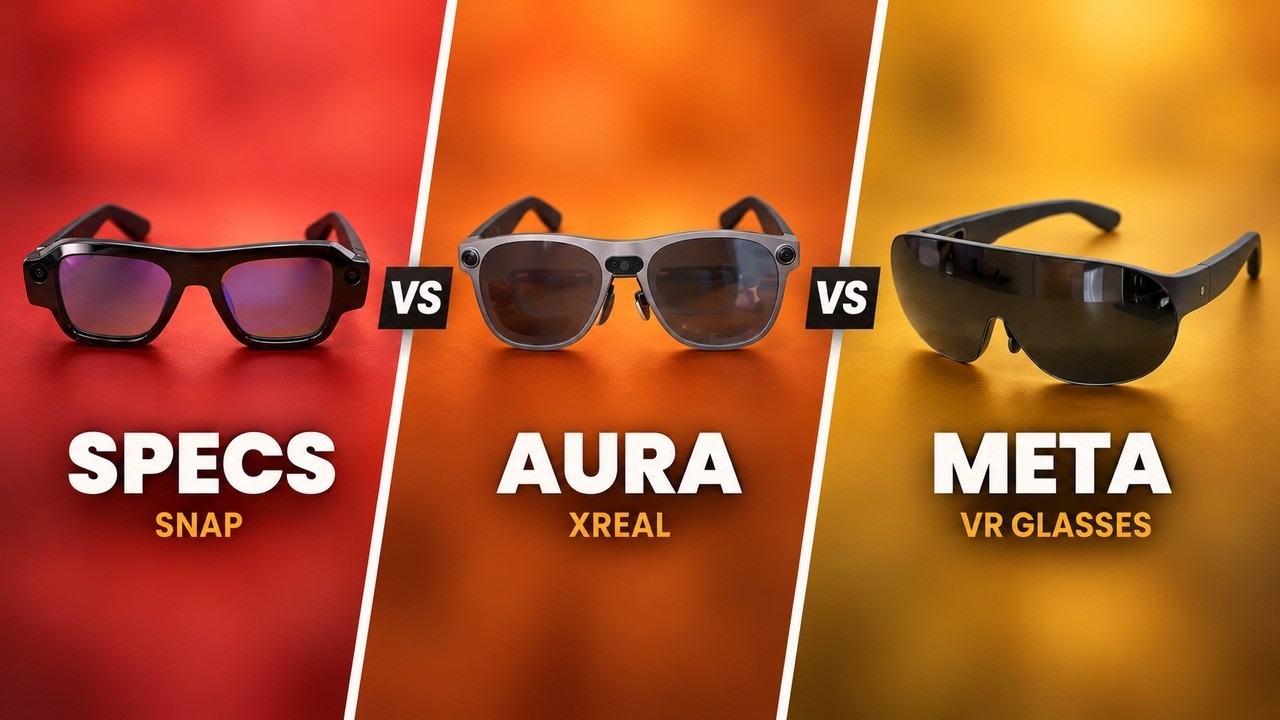
The First REAL AR Glasses Are Almost Here
I used Snap's Spectacles developer kit. The hardware is bulky and early, but the software already feels like a platform. Here's why that matters.
 By CasPublished Updated Video + article5 min read
Snap is planning to release what could be the first true AR glasses for consumers this year, and if you care about VR, this might matter more than you think. This isn’t about a floating screen. It’s about real holograms anchored to your world, like the stuff we grew up seeing in Star Wars or Iron Man. Think Pokémon Go, but without holding up a phone: you walk outside and it’s there. A lot of companies try to fake that, and real optical AR is much harder. So I got access to Snap’s developer kit, Snap Spectacles, to see how close we really are. What surprised me wasn’t what I expected.
This is a dev kit, and you feel it
First, to be clear: these are not the glasses you’ll be able to buy. They’re heavy, and the battery lasts about 45 minutes. This is early hardware, made so developers can start building before the final form factor is ready.
You notice that right away. The first time I put them on, my honest reaction was: this is bulky, and this is not what we ultimately want on our faces. Snap co-founder Evan Spiegel says the consumer version will be dramatically smaller, lighter and more powerful. That matters. But the experience was already better than I expected.
First impressions of Snap Spectacles
Lego, locked in place
The first thing I launched was a Lego experience, and what impressed me wasn’t the bricks. It was how fast the glasses understood my space. I didn’t have to scan the room and there was no setup ritual. Within seconds it found my desk and the surfaces around it, and I could start building. I placed pieces, asked for a different color with my voice and it appeared instantly. I could walk around it, lean in and crouch, and everything stayed perfectly locked in place.
Darts with four people on event Wi-Fi
Later, at an event, four of us played a darts game in the same physical space. We could see each other throw, see the darts land and compete in real time, on crowded event Wi-Fi, and it held alignment without breaking. That kind of shared spatial alignment is hard. A lot of early AR systems slowly drift, so digital objects shift out of place. That didn’t happen here.
Because you look through transparent lenses instead of camera passthrough like on Quest or Vision Pro, the holograms feel layered onto reality instead of rebuilt through cameras. It’s a different kind of stability.
Peridot multiplayer
Then we tried Peridot, a digital pet game, like a modern Tamagotchi in AR. Niantic, the team behind Pokémon Go, originally built it for phones, which tells you this isn’t just a random tech demo. It loaded almost instantly (that’s by design, more on it below). In multiplayer, when someone nearby was wearing Spectacles, it found them automatically and our spaces aligned within seconds, no manual syncing. We were simply in the same AR world, playing with each other’s Peridots. And yes, it was ridiculously cute.
The software already feels complete
What caught me off guard wasn’t any single game. It was how complete the whole thing already feels. The interface is beautiful, and there are lots of experiences to try, including practical tools.
One of the coolest is live translation. When someone speaks, subtitles appear anchored just below their mouth, and they stay there, even when you or they move. That’s when you realise this is also about layering information onto the real world in a way that sticks, which is what all the AI smart glasses are doing now.
The software doesn’t feel fragile. A few things it already has:
- Lens tinting, so the display stays visible in bright sunlight
- A travel mode
- Instant photo and video transfers
- Built-in screen recording
- A spectator mode, so someone on a phone can see exactly what you see
Those aren’t big features. They’re usability features, and they show Snap is already building what makes the technology practical. Most dev kits feel like experiments. This feels like the early version of a platform.
(This video also had a sponsored segment from Antigravity, about its A1 360 drone. That sponsorship covers that segment only, not my opinion of the Spectacles.)
The real limits
As impressive as it feels, the hardware is very much first generation:
- Field of view: 46 degrees diagonally, so it feels more like a window than holograms across your whole vision.
- Hand tracking: it relies on the front cameras, and their tracking range is fairly small, so your hands fall out of view easily.
- Compute: limited. You’re not running massive 3D worlds, and developers work within clear boundaries.
Inside that window, though, the display looks really good: vibrant colors, a sharp image and text that’s easy to read. The display is also noticeably taller than it is wide. That’s likely on purpose, because Snapchat is built around vertical content, so it feels purpose-built rather than adapted from VR.
None of this is bad. It’s what early true AR looks like. If you remember the original HoloLens, that thing was massive. Compared to that, this is real progress.
Socially, it already beats VR headsets. Those cover your face and signal that you’ve left the room. These still look like glasses (big glasses, but glasses), so you can keep eye contact and stay present. That matters more than we think.
Snap OS might be the real story
Everyone focuses on the hardware specs, but I think the real story is Snap OS. When we were at Snap’s Lens Fest last year, they unveiled Snap OS 2.0, and that’s when I realised they were taking this seriously as a platform.
Everything runs as something Snap calls a Lens: a self-contained AR experience that plugs into the system instead of taking over. The OS handles spatial mapping, rendering, hand tracking and shared alignment, and developers build on top of that instead of rebuilding it every time.
That creates consistency. Apps launch fast, interactions follow the same logic, and multiplayer is built in from the start instead of patched in later. That’s very different from XR platforms where every app reinvents the wheel.
It’s not an accident. Snap has been building AR software for over a decade through Snapchat, where millions of people already use AR effects every day, and it has spent years refining creator tools and shared AR. You can feel that maturity. Usually a new device arrives first and the ecosystem struggles to catch up. Here it’s reversed: the software feels ready, and it’s waiting for the hardware to shrink into something you’d wear all day. Hardware always improves. What matters is whether the platform is ready when it does, and Snap looks further along than most people realise.
Will it replace your Quest?
No, and you’re right if that’s what you’re thinking. If you want full immersion, VR still wins today. But this isn’t about replacement, it’s about where things are heading. VR, AR and display glasses won’t be separate lanes forever. They’re different paths that may eventually meet.
The real question is which device fits into daily life, and that’s the one you’re comfortable wearing for hours. Once something reaches that point, immersion becomes a mode you switch on, not a commitment you make. Then specs matter less than behaviour, and behaviour decides platforms.
So Snap Spectacles won’t replace your Quest, but they could be an early blueprint for where all of this is going. When the consumer version comes out, I’ll be testing it straight away. What do you think matters more for the next shift: better hardware or a stronger ecosystem?