This is the Nreal Light – FIRST AR Glasses For Consumers Available NOW
My impressions of the Nreal Light after a couple of weeks: 6DoF tracking, a giant virtual screen, and the limits you accept as an early adopter.
 By CasPublished Updated Video
VR is pretty much a big child by now, while AR is still in its infancy. It’s advancing fast though, and quietly, a bit like the beginning of VR. I think it will add a lot of value to our lives, so I’m starting to cover it alongside VR, beginning with the Nreal Light. It already launched in Asia and Germany, and as of this video you can buy it in the United States for $599. I’ve had a pair on loan for the past couple of weeks, so here’s what they can do, the good and the bad.
Some companies call their glasses AR when they’re really smart viewers with 3 degrees of freedom tracking. The Nreal Light offers 6 degrees of freedom spatial tracking. You tether it to your phone, place virtual objects in your real environment and walk around them naturally. I don’t think it’s entirely true AR yet, but it comes close, and I think it’s really cool to see how far they’ve come.
Design and fit
The glasses weigh about 160 grams and look like regular glasses from the outside, small enough to hang on my shirt. They do sit higher on your nose, which gives me a funny look. You get several adjustable nose pieces to fit different faces.
There’s no IPD adjustment, but the glasses should cover a range of 56 to 70mm. Mine is around 59mm and I could use them just fine.
A cable runs out of the left temple to your phone, and that brings me to the first con. The Nreal Light only works with certain 5G Android smartphones, so no iPhones or iPads yet. The list is limited, so check the compatibility list on Nreal’s website first. I tried it with a Samsung S10 and an Oppo phone, and both worked.
How the Nreal Light works
You install Nreal’s app, Nebula, from the Google Play Store. When you plug the USB-C cable into your phone, it should launch automatically. From then on:
- Your phone acts as a 3DoF controller with a laser pointer for menus, AR games and apps.
- A small touchpad appears on your phone for tapping and swiping.
- A home button takes you back to the home screen. Long press it to recalibrate the laser pointer.
The speakers under the frames sound pretty okay and there are dual microphones, so you could meet up with people too. You can also use any headphones that connect to your phone, over Bluetooth for example.
The magic is in the compound light guide modules. Small micro-OLED displays at 1920 by 1080 per eye project the image downwards, and it’s then reflected in front of your eyes. Both displays blend into one screen that looks superimposed on the real world.
A proximity sensor checks if you have them on, and two visible light cameras and IMUs track your head in 6DoF. Plane detection lets you fix a virtual object to one spot and walk around it. I played a cute tower defense demo this way, called Table Trenches.
Filming what I see through the glasses is really tough and causes performance drops. So the footage has lower frame rates and visual quality than the real thing, and in real life the image is also slightly more transparent.
Two display modes
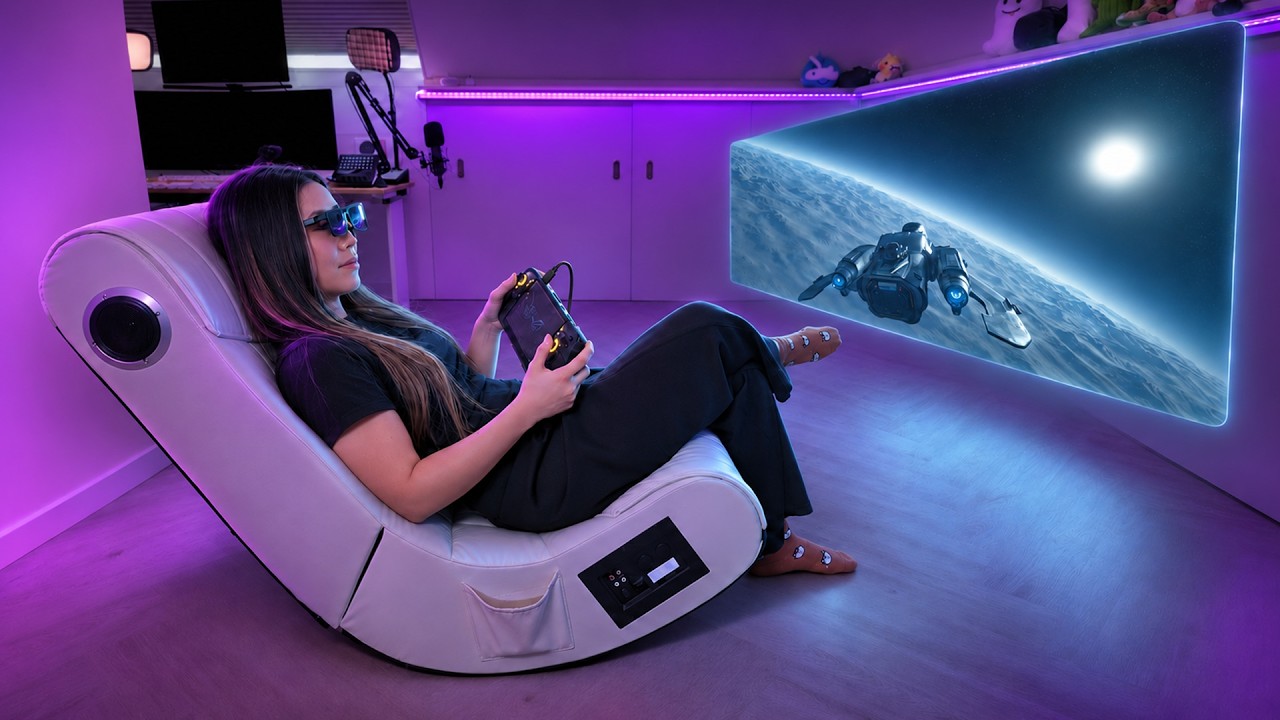
MR Space is where the AR games live. There are already a turn-based fantasy game, a tower defense game and meditation apps. You can also open up to five 2D apps or web pages and place them anywhere around you, closer or further away, bigger or smaller. They stay where you put them, and one button regroups everything in front of you. Watching YouTube while scrolling Reddit feels very Minority Report, and I expect it to get even cooler when hand tracking arrives. You can also lean back and watch Netflix on a screen that looks giant.
Air Casting mirrors your phone screen into your view, or casts a streaming app from your phone to the glasses. You can use your phone without getting text neck, which I think could be really good for your posture. The cable and temples get a bit in the way if you lie down on a pillow, though. Complicated tasks are also harder because you can’t see your fingers, so it’s easy to misclick, but you can quickly look down at your real phone underneath the glasses.
Air Casting has two screen modes. Immersive fills the glasses’ whole field of view. Side screen makes the picture smaller and moves it to the side, so you can do something else while watching.
That second mode surprised me most. I love putting on a podcast while I cook or clean, and with these I could watch a Netflix show or keep a recipe in view instead. The glasses even stayed on my tiny nose. Active cleaning will make them fall, unfortunately, but standing on an elliptical was possible.
Display quality
The visual quality is good. It has beautiful colors and deep blacks, and text is sharp and easy to read. There are some problems, though:
- Motion blur. It’s noticeable when I move my head fast, maybe because of the refresh rate of up to 72Hz or the type of display. It’s fine for videos, Reddit and light AR games, and would be more of a problem for faster movement, which I haven’t found a purpose for.
- Brightness. Even at the highest setting, the peak brightness isn’t always enough. Bright light from a lamp, a monitor or an open window makes the image hard to see, and you get reflections on the lenses. You can’t use them outside in the sun. I tried, and it just won’t work. They work best inside or when it’s darker.
- Field of view. Nreal rates it at 52 degrees diagonal. When you look around a lot the image gets cropped, which takes you out of it a bit. Most AR glasses I’ve tried have this problem, even the ultra-expensive HoloLens.
The screen still looks huge, though. Nreal claims it looks like a 115-inch TV, and I don’t think they’re far off. Our TV at home is about 77 inches, and the Nreal Light’s image definitely looks bigger from my normal TV-watching spot.
Battery drain
This is one of the biggest cons right now: the glasses drain your phone fast. It depends on the phone, but I get about 2 hours at most. The glasses turn themselves off when your phone has about 30% battery left.
Price and what’s in the box
When this video came out, the Nreal Light cost $599 in the United States, online or in a Verizon store. It’s only available in the US, Germany, Spain, Japan and South Korea for now. In the box you get:
- The glasses and a nice case
- Multiple nose pieces and nose pads
- A cover for immersive VR mode
- A cleaning cloth
Who the Nreal Light is for
It’s one cool piece of tech, and I think Nreal did a great job with it, but it’s not perfect yet. To me, true AR needs a wider field of view, full 6DoF interactions and realistic occlusion of virtual objects, amongst other things. Nreal is getting us there faster than I expected.
Whether you should get one depends on what you want to do with it. Multitasking and streaming are already pretty advanced, while games are still lightweight. Much of what you can do will depend on how many developers see value in building for it. Hand tracking, for example, already works, but I couldn’t test it because you can’t do much with it yet.
So if you get one, you’re an early adopter, and you have to be prepared to wait for the software to catch up. I guess that’s also kind of magical, just like the beginning of VR.