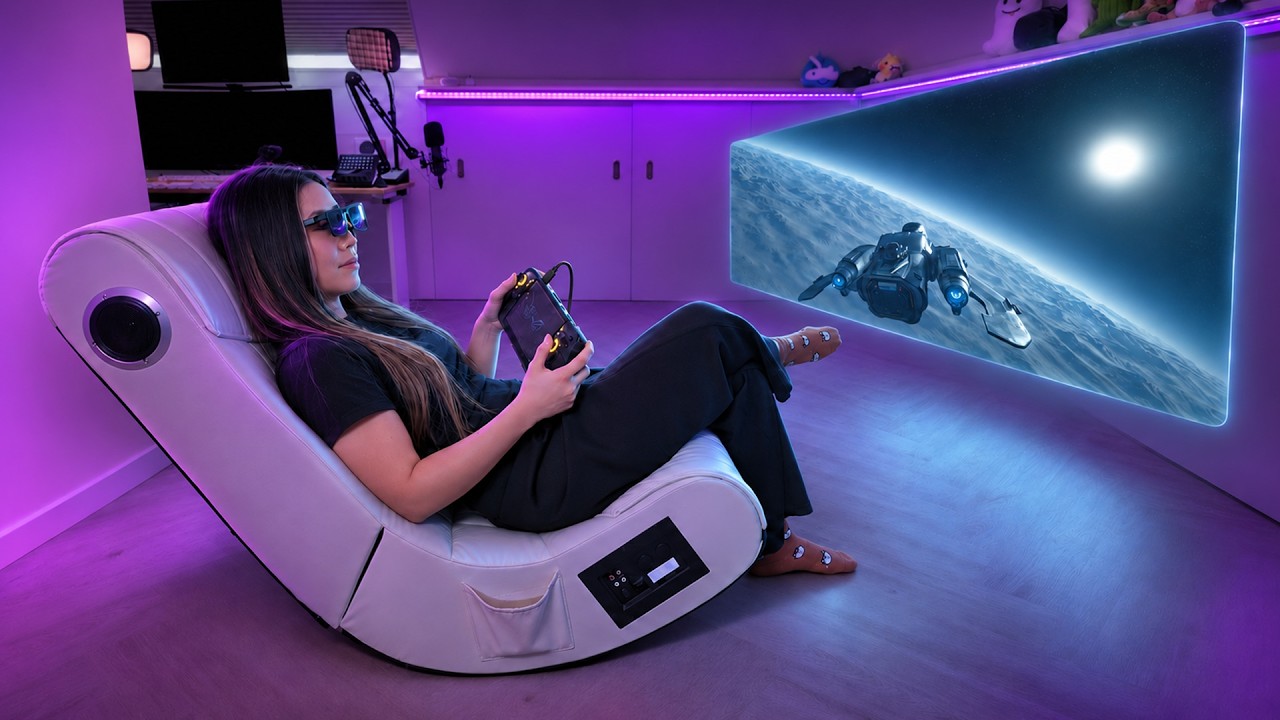
RayNeo GT Max: Their Best XR Glasses Yet?
RayNeo's GT Max brings prism lenses, a 59° field of view and built-in 3DoF for $399. Here's what that buys you and the one design choice that limits it.
 By CasPublished Updated Video + article5 min read
The GT Max might be the best pair of XR glasses RayNeo has out right now, and it’s the pair they’ve been missing: prism lenses and native 3DoF running off a chip inside the glasses, with no extra hardware. Every other big name has had that for a while. RayNeo’s whole thing is keeping it affordable, though. The VITURE Beast costs $549, the GT Max is $399. To get there RayNeo made choices the others didn’t, and in this RayNeo GT Max review I go through what those choices give you and what they cost.
RayNeo sponsored this video and sent a second unit for a giveaway. That pays for our time, not for the verdict.
Specs
RayNeo announced two pairs, the GT and the GT Max. I only had the Max for this video. The big difference: the regular GT uses birdbath optics with a 46° field of view, while the Max uses RayNeo’s new prism optics and gets 59°, which is currently the widest in this category.
- Chips: two. The Vision 4000 handles the picture, the Zone 360 handles spatial tracking.
- Displays: a 0.6-inch micro-OLED per eye, 1920 x 1080, 38 pixels per degree.
- Brightness: RayNeo claims 1,200 nits, with an AI-powered SDR to HDR mode on top.
- Screen size: a 267-inch virtual screen by default, scalable to 115% or 85% in the settings.
- Audio: a quad speaker setup tuned by Bang & Olufsen, with a 5 dB boost in the low end, plus head-tracked spatial audio (the regular GT doesn’t get that).
- Weight: RayNeo says 78 grams without the cable. I measured 81 with the nose pad.
In the box you get the case, cables, documentation, anti-slip temple pads (new to me), a cleaning cloth, two extra nose pieces in different sizes and a prescription adapter sample. A nice, efficient package.
Design and comfort
The design is still very RayNeo. Like most of their glasses, there’s a plastic front cover. It looks great on, but it doesn’t detach, and that matters later.
The frames are lovely. USB-C sits on the right. The left temple has volume and a menu button, and the right temple has a second button with a red ring around it, a nice touch, which toggles the spatial modes. The new prism lenses are small and thin, which changes how the glasses sit. They’re comfortable, hug your face and stay put.
What I miss:
- Adjustable temples. These don’t move at all, and on other glasses those two or three click positions do a lot for finding the sweet spot.
- Diopter dials. There are none, so if you wear glasses you’re buying the prescription adapter.
One thing that’s easy to skip past: the Max comes in three physical sizes. Pick the one closest to your IPD, because it makes a difference for sharpness.
How they work
They plug into anything with USB-C DisplayPort: phones, laptops, tablets, handhelds, consoles. For most things you no longer need an app.
The left button opens a menu on the glasses with brightness, 3D modes, scene presets, colour enhancement, screen size and Dynamic Quality (where the AI SDR to HDR conversion lives). There’s also Whisper Mode, which cuts down how much audio leaks out to whoever sits next to you.
The right button cycles three spatial modes:
- Follow Mode. The screen follows your head.
- Steady Mode. The same, with stabilisation on top.
- Pinned Mode. The 3DoF mode, which locks the screen in place in front of you. Hold the button to recentre.
The only thing that still needs the phone app is 2D to 3D conversion, plus a few extras.
3DoF and picture quality
What surprised me the first time was how well Pinned Mode works. There’s almost no motion blur. On other glasses with 3DoF, text usually smears the moment you turn your head. Here it holds together.
There’s no camera on the front, which makes sense: 3DoF is rotation only, so a motion sensor can do the whole job, and cameras are for positional tracking. The practical result is that it doesn’t care about light. In a dark room it tracked exactly the same. I walked around with Pinned Mode on and the screen stayed where I put it. I also took them on a plane, which is what Steady Mode is for, and it held the whole way through all that small constant movement. I watched most of a film without touching the settings. I only saw some warping when I went looking for it.
Text is really crisp through the middle, and the sweet spot is big, roughly three quarters of the screen. There’s some chromatic aberration right at the far edges, but it’s minor and better than most glasses I’ve used. With a screen this wide I do turn my head a little to look at an edge, which brings it back into the sharp zone. I still prefer Pinned Mode over anything else. Without 3DoF the extra field of view wouldn’t be usable screen space. With it, the whole 59° is doing something, and even as peripheral vision it’s really nice.
How they sound
The audio genuinely surprised me. The Bang & Olufsen tuning does real work: there’s more body than I thought was possible, and the bass feels full instead of thin, which I don’t often say about glasses speakers. Maybe that’s the 5 dB low-end boost. Against most glasses I’ve worn this year, these are noticeably better.
The head-tracked spatial audio works, so the sound stays where the screen is when you turn your head. But everything goes softer and a bit muffled, and that body drops out, so I usually leave it off.
The low end starts distorting at about 12 out of 15 on the volume. To RayNeo’s credit, they marked that point with a red line in the volume bar.
Dynamic Quality and 2D to 3D
I quite like Dynamic Quality. With AI SDR to HDR on, there’s more contrast and skin tones look more natural, less yellow. It can be darker than you want, especially in darker games, but I started leaving it on for films.
In the RayNeo XR app you can convert your own photos and videos to 3D. Proper side-by-side 3D looks really good on glasses like these, because each eye gets its own display. The AI conversion is more mixed. Horizontal video works much better than vertical, and depending on how well it separates foreground from background you’ll see artifacts, but it does better than I expected. You can only convert what the app lets you, though. I’d rather it ran on the glasses, so anything on the screen could become 3D.
The trade-offs
- Brightness. At its highest setting the screen seems slightly dimmer than my other glasses. The tinted cover makes up for a lot of it and it’s still perfectly visible in daylight, but the difference is there.
- Warmth. The right temple gets warm after a while. Not hot, but you notice.
- Reflection. Like every prism lens I’ve used, there’s a reflection of the screen along the bottom. It’s most visible with white text on a dark background, so heavy subtitle watchers might mind.
- The cover. This is the biggest con for me. The cover doesn’t come off, and it’s dark enough that you can’t see your laptop screen through it well enough to use these as an extra monitor. That’s exactly what I’d want for remote work. Electrochromic dimming would fix it: tint up for a film, down for work. As they are, they’re a one-screen device, not a second-screen one.
Pocket TV Pro and Dolby Vision
RayNeo also sent the new Pocket TV Pro, a Google TV device you plug the glasses into, so you get Netflix, YouTube and everything else without touching your phone. It doubles as a 6,500 mAh power bank, RayNeo claims up to five and a half hours of continuous watching, and its 64 GB of storage expands to 2 TB.
The new part is Dolby Vision. RayNeo says the GT Max and Pocket TV Pro together are the first video glasses system with native Dolby Vision. I tried it, and wow: much more detail in the shadows and highlights, and it doesn’t go dark on you the way the AI conversion does. It looks beautiful.
Worth knowing:
- It only works through the Pocket TV Pro. Plugging your phone into the glasses won’t give you Dolby Vision.
- Not everything is in Dolby Vision. I had to go looking for a Netflix show that had it.
- With Dolby Vision on, Dynamic Quality is greyed out. That’s the right call: you don’t want AI guessing at HDR on top of content that already has it.
At launch the Pocket TV Pro was $199 on its own or $559 in a bundle with the glasses. If Dolby Vision is why you’re buying, you’re looking at $559, not $399.
RayNeo GT Max review verdict
RayNeo has done what RayNeo does. These glasses do one thing extremely well: making films, video and games look and sound great. 59° for $399 is the most field of view I’ve seen for the money, and the 3DoF is better than most first attempts I’ve tried.
You can work on them. What you can’t do is use them as a second monitor, because you can’t see your laptop through the shade. But if you want one giant cinema screen you can fold into a case and take anywhere, these are really good. RayNeo put them on sale on September 4 at IFA for $399. I’m testing the 46° GT next, to see what that extra field of view is worth in money.