Google I/O 2026: The Smart Glasses Reveals Everyone’s Waiting For
The three XR reveals I was watching for before Google I/O 2026: Project Aura, Google's own glasses and Samsung, plus which XREAL glasses to buy now.
 By CasPublished Updated Video + article4 min read
Google I/O 2026 was one week away when we made this video, and there were three things I was watching for on the XR side: a release date for XREAL’s Project Aura, the first look at Google’s Gentle Monster and Warby Parker smart glasses, and a Samsung teaser for its own glasses. None were guaranteed, all were on the table. Chary and I were flying back to Mountain View for it. Our first I/O, the year before, was where we tried the Samsung Galaxy XR and Google’s XR glasses before nearly anyone else. Here’s what I was watching, and what I thought was realistic versus wishful thinking. Nobody sponsored this video.
Why this keynote matters
Android XR, Google’s operating system for headsets and glasses, was announced in December 2024 with Samsung and Qualcomm. At I/O 2025, Google added the Warby Parker and Gentle Monster eyewear partnerships and showed more of Samsung’s headset. Since then, things have shipped:
- The Samsung Galaxy XR launched in October at $799, the first Android XR product you could buy.
- At CES in January, Google extended its partnership with XREAL and named it a lead hardware partner for Android XR, specifically for optical see-through glasses that overlay digital content on the real world. That’s Project Aura.
The lineup is taking shape. Samsung leads on the headset and is working on simpler AI glasses with and without a display, similar to the Ray-Ban Meta and the Meta Ray-Ban Display. XREAL leads on actual AR glasses with real spatial overlays. So when Google takes the stage on May 19, it can’t be another “here’s what’s coming someday” keynote. There’s a real ecosystem now, and Google has to show momentum.
Project Aura: the number nobody saw coming
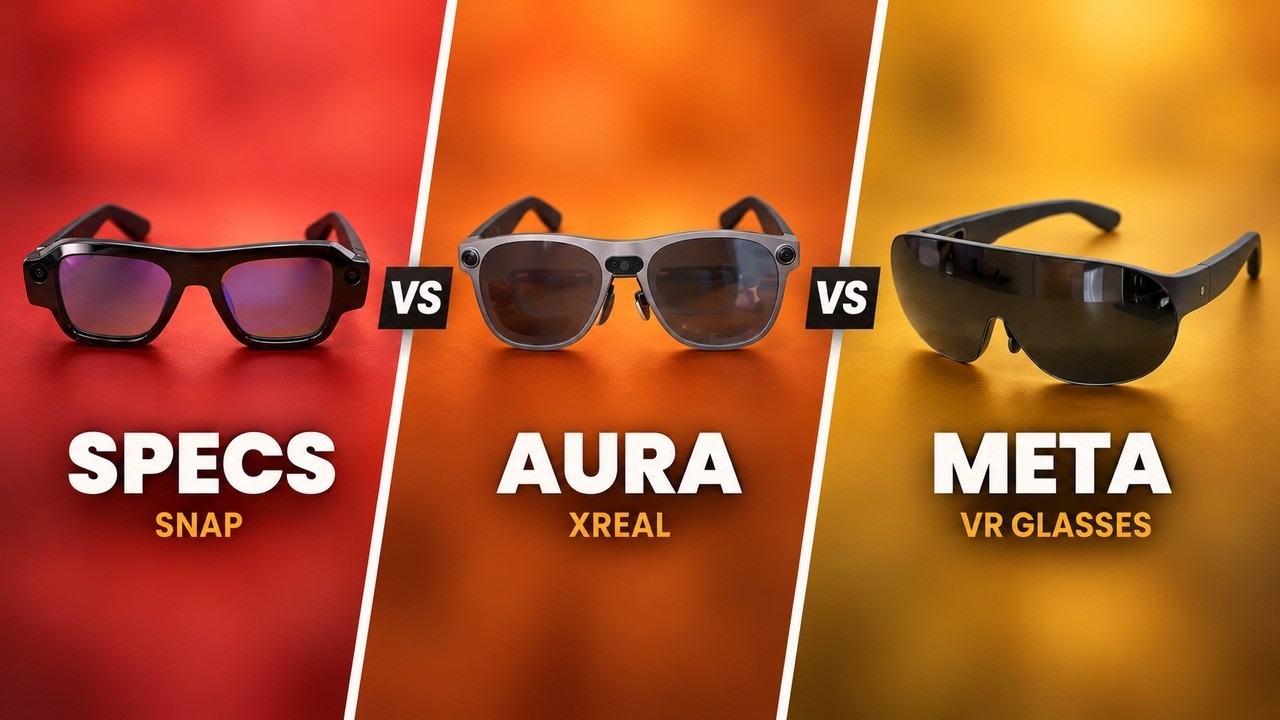
Aura is XREAL’s first pair of glasses built specifically for Android XR, a partnership between XREAL, Google and Qualcomm. On paper it blurs the line between AR glasses and what full VR headsets can do. We don’t have every spec, but from what XREAL and Google have shown, it looks closer to a Galaxy XR style headset squeezed into glasses than a simple second-screen viewer. And it looks like glasses, not a bulky face computer, which in this category isn’t a given.
What we knew from public hands-ons going in:
- A 70° field of view. That’s the number I keep coming back to. The XREAL One Pro has 57°, already very wide for AR glasses. XREAL’s North America general manager called Aura’s “irresponsibly large”, on camera.
- A puck does the heavy lifting. Android XR, the apps and the AI run on a Snapdragon-powered puck in your pocket.
- The X1S chip in the glasses handles tracking, display stability and low-latency rendering, so the glasses stay light. It’s the next generation of the X1 chip in the One series: around 25% faster, built for multitasking, with the same 3 ms motion-to-photon latency that makes the One Pro feel so stable.
XREAL has confirmed dev kits roll out this year, so developers get Aura first. Whether the rest of us can buy one in 2026 is the part nobody has answered. A real timeline for normal people was near the top of my I/O wish list.
What XREAL quietly shipped in the meantime
The One series uses the same chip family and approach, so it’s the closest preview of how Aura might feel. Since the One Pro became generally available, XREAL has shipped five major firmware updates, with real features, not bug fixes:
- Real 3D. 2D to 3D conversion of movies, YouTube clips, old flat games and photos in real time. I expected XREAL to add it at some point. What’s interesting is that it runs entirely on the X1 chip in the glasses, with no app or host device doing the work. It runs at 30 frames per second across the One series, so it’s great for movies and casual games, less so where refresh rate matters. That may improve with updates.
- Ultra-wide modes. Next to 32:9, there’s now 21:9, which is great for laptop work. The 57° field of view limits how big that feels: it’s more like looking at an ultra-wide monitor through a window. Aura’s 70° will probably have the same window effect, just a much bigger window.
- A vertical mode, perfect for doom scrolling shorts.
- Smaller additions: screen levelling to fine-tune the horizontal alignment of your screen, customisable double-tap shortcuts, and quick adjustments of brightness, tint or volume with the volume buttons.
None of those is a headline on its own, but together the One series is a noticeably different product than on day one. I already love working on my One Pro, especially when I travel.
Which XREAL glasses to buy right now
- XREAL One Pro: the flagship, with the widest field of view, flat prism lenses and two physical IPD sizes for the best fit. The best video glasses XREAL makes today.
- XREAL 1S: the best value. Same X1 chip, same 3 ms latency, same 120 Hz, and it supports Real 3D and the ultra-wide modes too. The field of view is slightly smaller and the optics bulkier, but if you want the premium experience for less, this is the one I’d recommend.
Knowing what’s coming with Aura, though, you might want to wait for its pricing and timeline if you’re not in a rush.
Google’s own smart glasses: what I’ve seen so far
At I/O 2025 I tried Google’s prototype, with a small translucent colour display in the right lens. It’s low-key, more like a smartwatch for your eyes than full AR. Time and weather floated up when I put them on. I pointed them at artwork, asked Gemini what I was looking at, and it described it in real time. There was a nearly invisible camera, and photos showed a preview in the lens. The form factor was smaller than I expected. Compared to the Meta Ray-Ban Display, the exciting part is everything Google already brings: Maps, Translate, Gemini. But that was prototype hardware, with no production design.
At MWC in March, I tried the next software update, the first time Google showed the glasses publicly outside I/O:
- Nano Banana through the camera. We pointed at a stack of books and asked Gemini to put Spider-Man on top, and the image came back with him perched there like he’d always been.
- Real-time translation, with someone speaking Chinese and Dutch and English captions appearing in the lens.
- Casting to an external display, so others see what you see. That makes showing these glasses much easier for us.
Still no consumer design, though. Warby Parker and Google confirmed in December that the glasses launch in 2026. A developer keynote is a logical moment to put a real product on stage, though it could also come a bit earlier at the Android Show on May 12, and Google has held things back before. My guess: a hardware reveal with at least one of the partner frames, a launch window later in 2026, and probably no price yet. A price would be the bonus round.
Google’s glasses and XREAL’s aren’t really competing. Google’s are lightweight, all-day, AI-first eyewear. XREAL is in a different lane, with slightly bulkier optics but big cinematic displays for content, productivity and maybe AR-style gaming. Same OS, different jobs, which is the point of Android XR as a platform.
Samsung’s two-tier plan
I/O is Google’s show, but Samsung is worth watching. It confirmed in January that its smart glasses launch in 2026, and in April code references in Samsung’s One UI 9 firmware pointed to two models:
- Jinju, reportedly the entry-level pair: no display, just cameras, microphones and Gemini, around 50 grams and somewhere between $380 and $500. Basically Samsung’s answer to the Ray-Ban Meta, tracking for late 2026.
- A premium model with a micro-LED display for contextual overlays and notifications in your line of sight, looking more like 2027 at a reported $600 to $900.
That’s a clear two-tier strategy: cheap AI glasses now, premium glasses later. It’s the same playbook Meta used with the Ray-Ban Meta and the Meta Ray-Ban Display, a little behind. Samsung usually saves big reveals for its own Unpacked events, so at I/O I expected a teaser at most. Either way, by the end of 2026 Android XR won’t be a one-headset platform anymore. I think that’s the real headline.
The bigger question for Google I/O 2026
Going in, Aura was getting close, Google’s glasses were likely getting their real reveal, and Samsung was lurking. XREAL is quietly turning into one of the most important names in this space, both for what’s coming and for what you can already wear today. The bigger question for me: are the AR and VR lines finally merging this year? I couldn’t wait to find out.