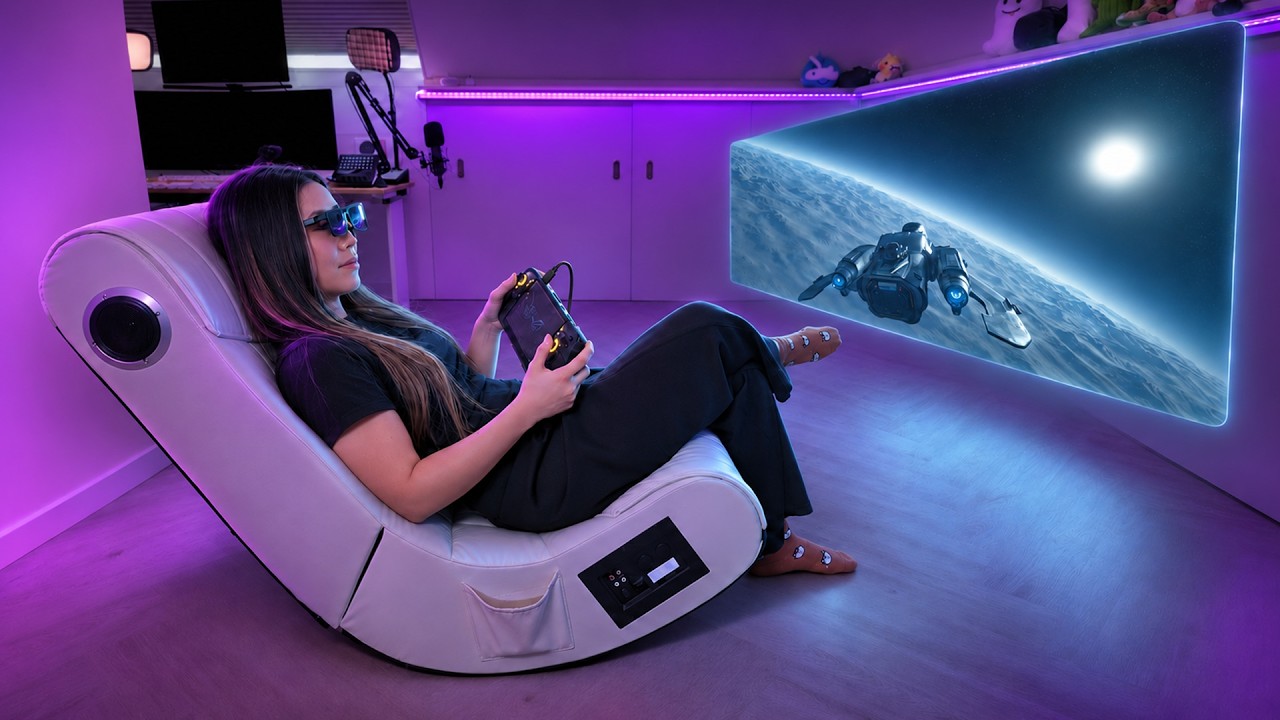
HERE’S What AR Glasses Will Be Like In 2023!
At the Snapdragon Summit, Qualcomm showed the AR2 Gen 1 chip for slim wireless AR glasses, plus mobile chip news that could change VR.
 By CasPublished Updated Video + article5 min read
When you think of AR glasses, you probably don’t picture bulky headsets with a cable to your phone. You picture glasses that look like regular ones, wireless, doing AR that reminds you of Minority Report. I thought that was still far away, so I was surprised to see a company working on glasses like that as early as 2023. That company is Qualcomm, and its new Snapdragon AR2 Gen 1 chip is built for exactly this.
Last month we were at the Snapdragon Summit in Hawaii. Qualcomm invited us to see what they’ve been working on. They didn’t ask us to make this video; I’m just too excited not to. A segment of the video was sponsored by Kiwi Design, which had no say in this.
Why Qualcomm matters for VR and AR
Qualcomm makes the chips in most Android phones and in most VR and AR headsets. Without them, standalone headsets wouldn’t exist. The chip decides how good your graphics look and whether features like hand tracking are possible. So whatever Qualcomm does affects our whole industry, and its yearly summit is the event to watch for a sneak peek at the next generation of headsets.
There wasn’t much VR news this year. But when I talked with Hugo Swart, Qualcomm’s vice president of XR, he hinted that we should keep a close eye out, because we might hear something next year.
New phone tech that should come to VR
Qualcomm announced the Snapdragon 8 Gen 2 mobile platform for phones, and some of it should cross over to VR:
- Hardware ray tracing. In the phone gameplay they showed, the difference with and without ray-traced reflections looked amazing. Some mobile games already have ray tracing, but in software. Doing it in hardware should be much more powerful and efficient. Imagine that in VR games.
- Unreal Engine 5 MetaHumans support. That should allow far more photorealistic human characters. Imagine that in Quest 2 games.
- Dedicated AI processing on the chip, so AI features run faster. VR headsets use AI for things like controller tracking, so this should help VR too.
I can’t be sure these will come to VR right away, but I think it’s a matter of when. I’m curious whether they’ll be in the new VR chip next year.
Snapdragon AR2 Gen 1: a chip made only for AR
At the summit, Qualcomm took the wraps off a new chipset focused on AR that should lead to lighter, more stylish glasses with stronger AR. It’s the first time Qualcomm made a chip for one field only. Until now one chip covered VR, AR and MR: the Snapdragon XR2 powers VR headsets like the Quest 2 and Pico 4, and AR headsets too.
With the AR2 Gen 1, Qualcomm split the chipset into three parts that sit in different places in the glasses:
- an AR processor,
- an AR co-processor,
- a connectivity chip.
The biggest benefit is heat. Instead of one spot getting hot, the heat spreads through the frame, so AR2 glasses can use smaller batteries and much lighter cooling than other chipsets. Every decision seems made to allow a smaller form factor.
It needs a phone or PC, but no cable
Qualcomm also decided what has to run on the glasses and what doesn’t, until the technology gets better. AR2 isn’t made for standalone devices, so the glasses can’t run apps on their own. They connect to a host device like a smartphone or PC, but wirelessly. A cable isn’t practical when you’re running outside to catch a shiny Pokémon.
The connectivity chip sits in one arm and handles low-latency, low-power streaming over Wi-Fi 7. It’s the first AR solution with Wi-Fi 7, and Qualcomm claims latency under 2 milliseconds, which most people shouldn’t notice. That only matters once Wi-Fi 7 phones are common, but they’ll get there. I tried the streaming on a reference design. It used an older chip, because AR2 chips weren’t ready yet, but the stream looked good and tracking and latency were fast.
Sending heavy work to the host frees up the glasses for the latency-sensitive jobs, like positional tracking.
The AR processor
The AR processor sits in the other arm and handles perception and the display output. It’s powerful:
- support for up to 9 cameras at once,
- a dedicated hardware engine for better motion tracking,
- an AI accelerator to cut latency for hand tracking and 6DoF,
- a reprojection engine that helps prevent dropped frames. Laggy video is nauseating, so it makes sense to keep this on the glasses.
The co-processor
The co-processor sits in the bridge of the glasses. It handles eye tracking and iris authentication for foveated rendering, combining camera and sensor data so the glasses only work hardest where you’re looking. That saves power.
Who is building AR2 glasses
The big question is adoption. Qualcomm showed that a dozen leading device makers are already using the AR2 Gen 1 to build products, including Lenovo, LG and other familiar names. Even Pico is on the list. Meta isn’t, though it has signed a multi-year strategic agreement with Qualcomm, so we’ll have to wait and see.
The most interesting partner for me is Niantic, the Pokémon Go developer, and that’s about more than me being a Pokémon fan. Niantic is making an AR headset that would let you catch Pokémon in a way I’ve only dreamed of. It’s still a prototype and doesn’t look like regular glasses yet, but this is where we’re going. During the keynote they showed it in action (without Pokémon, sadly). The graphics may look a bit gimmicky this early, but look past that: wireless AR glasses in a small form factor that seem to have 6DoF tracking and what looks like real AR. They didn’t have a unit for me to test.
Watch out for “AR” glasses that aren’t
Today’s AR glasses are often tethered to your phone. That makes them hard to walk around with, and their screens aren’t bright enough outside. Also be careful online, because some glasses are sold as AR when they really aren’t. Real AR means you can walk around virtual objects in your real room, and they respond when you interact with them. The glasses should detect and track surfaces, so if you send your virtual pet monkey to climb the wall next to you, it knows where that wall is. Based on Niantic’s trailer, their glasses can do all that.
Content: Snapdragon Spaces
Beyond hardware, Qualcomm wants to help bring good AR content with Snapdragon Spaces, an XR platform developers can build on. Other game engines are supported too.
What the Snapdragon AR2 Gen 1 means for AR glasses
It’s hard to say when products with the Snapdragon AR2 Gen 1 will reach consumers. But Qualcomm seems to have found a way to make AR glasses more stylish and practical: split the work, spread the heat, and let your phone do the heavy lifting. Focusing a chip on one area might be the best way to go, and I hope Qualcomm does the same for VR. I’ve always been excited about AR, so I’ll keep covering it and review these glasses when consumer versions come out.