XREAL AURA: This Shouldn’t Be Possible in Glasses
Four hours with XREAL AURA, the first Android XR glasses on Snapdragon Reality Elite: how it works, the puck, apps, comfort, the gaps and whether to buy.
 By CasPublished Updated Video + article7 min read
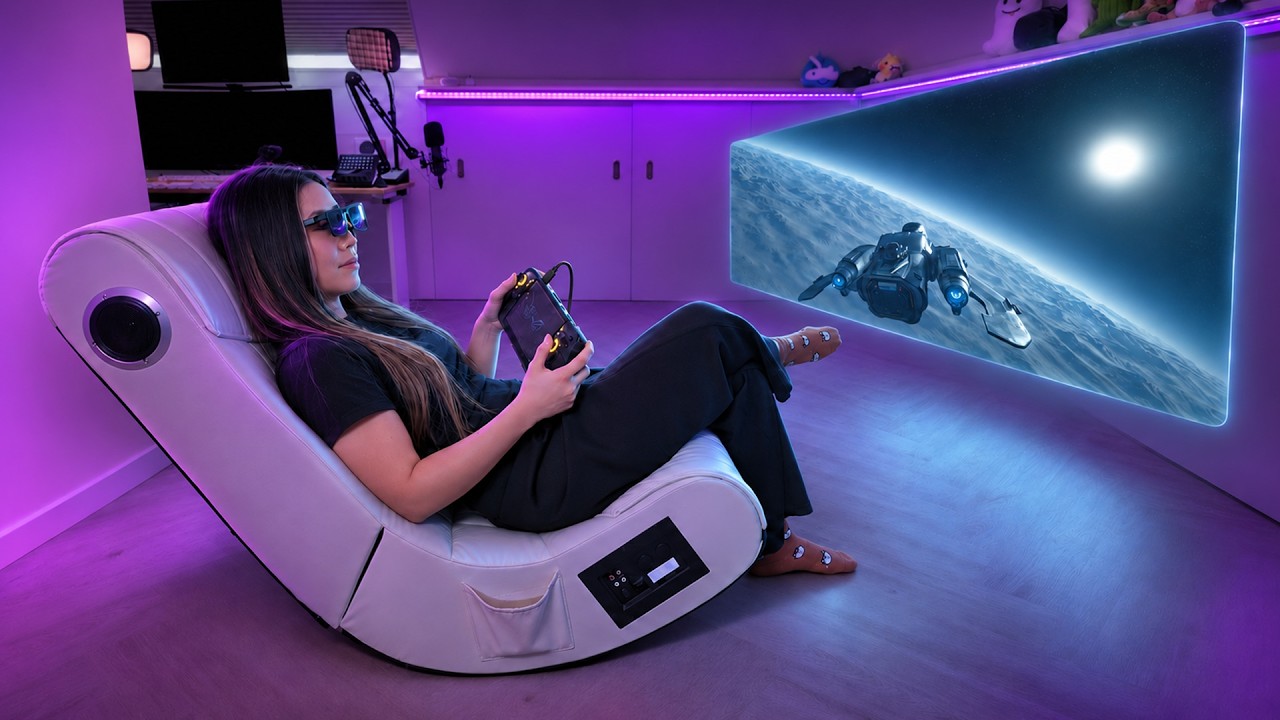
The XREAL AURA is a pair of glasses that gives you giant private screens floating in front of you, anywhere. It’s the first device on Snapdragon’s most powerful XR chip and runs Android XR, built with Google, so it does a lot of what people buy a Vision Pro for without the weight, the isolation or the price. These are my XREAL AURA first impressions after about four hours of wearing it at events: where it lives up to the big claim, where it falls short, and what I still need to test before I can fully recommend it. Honestly, I think it’s the most interesting head-worn device we’ve had in years.
XREAL partnered with us on this video. We were going to cover AURA anyway, and it doesn’t change how we review things.
How the XREAL AURA works
AURA comes in two pieces: the glasses and a puck about the size of a phone that you clip on, connected by a cable. The puck is the brain. It runs the new Snapdragon Reality Elite chip and Android XR and does the heavy lifting, while the glasses are the display. From what I’ve seen, it’s mostly the same Android XR as on the Samsung Galaxy XR.
Inside the glasses, two displays beam the image into prism lenses in front of your eyes, so the picture floats in your view while you still see your real room through the glass. On the front is a separate electrochromic layer with five levels of dimming, from basically transparent to basically blocked out. Because it’s optical see-through rather than camera passthrough, it saves a lot of processing power.
Tracking and controls
Two world-tracking cameras plus an RGB camera on the front handle head and hand tracking, and this surprised me: it’s full 6DoF. You can walk around and digital objects stay put. It feels like proper AR rather than a floating screen.
- Control it with your hands: pinch to select, gestures to scroll.
- Or use the puck like a laptop trackpad, or connect a Bluetooth keyboard and mouse.
- Hand tracking was more stable than I expected. It only struggled when my hair fell in front of the cameras.
- There are dead zones where the cameras can’t see your hands, and XREAL told me hand tracking won’t work in a dim room. Then you use the puck’s trackpad instead.
- The front RGB camera takes photos and video, and you can ask Gemini about whatever you’re looking at. A privacy LED shows people when you’re filming.
Displays and optics
- Two Sony micro-OLED displays, 1920 x 1200 per eye
- Up to 120Hz
- 70° field of view, the widest of these glasses-style devices right now
It looks really beautiful so far, and wide enough for films and games. It’s wider than it is tall, though, so even at the darkest dimming it doesn’t wrap around you. I played Demeo, which started as a VR game, and it looked amazing, but you notice you’re looking through a rectangular window.
Text was sharp and readable, video looked great and gaming was a lot of fun. Where I think it will hit its limit is heavy work that needs a lot of window space, like video editing or coding. I want more time to test that.
One thing that confuses people: these look like sunglasses but sit further from your eyes than real glasses. They’re a different kind of device from waveguide glasses like Snap’s SPECS, which sit right up against your eyes. XREAL uses prism lenses, which are cheaper and a bit bulkier, but noticeably smaller than the birdbath optics in its older glasses. They can’t replace your everyday prescription glasses and don’t work as sunglasses either. I’d frame AURA as a sleeker, more wearable take on what headsets do, trading field of view and opacity for a lighter form. It’s its own category.
The puck: deal-breaker or genius?
The puck has a premium design, and its whole front is a trackpad you use like a mouse, with gestures for scrolling. It runs the operating system and most of the computing. XREAL’s own X1S chip in the glasses is a co-processor for the low-latency spatial work, driving the displays and sensors, and camera data is processed on the glasses instead of travelling down to the puck. That split keeps the glasses light and the image stable.
- Clips: a removable clip for your trousers and another for wearing it around your neck. XREAL told me not to put it in a pocket. My guess is heat, though they said it won’t overheat on your trousers or neck.
- Buttons: volume buttons on the side, one doubling as a fingerprint sensor, handy for logging in or unlocking a password manager.
- Configurations: 12 GB of RAM with 256 GB of storage, or 16 GB with 512 GB.
- Battery: 4,455 mAh, which XREAL says is around four hours of mixed use.
- Ports: two USB-C, one for the glasses and one so you can charge while using it.
Snapdragon Reality Elite
AURA is the first XR device on the Snapdragon Reality Elite. Compared with the XR2+ Gen 2, it promises around 60% more GPU performance, 30% more CPU, and a 160% jump in NPU performance for AI, at 48 TOPS. On paper that means AI running on the device, offline, faster and potentially more private. I don’t know yet how much of that AURA delivers, it’s up to each developer to use it, and something like Gemini may still need the cloud. But the potential is big. I go deeper on the chip in a separate video.
Does it beat the XREAL One Pro? Yes, because it has the sensors, Android XR and the puck. That’s also why the One Pro can’t be used with the puck, which I confirmed, unfortunately. If you want the full Android XR experience, I wouldn’t get the One Pro over this.
What you can actually do with it
This is the part I had the most fun with. XREAL told me anything that runs on Android XR should work on AURA, which means new experiences made for Android XR plus millions of phone and tablet apps from the Google Play Store.
What I tried:
- Demeo, with crossplay against people on other devices, which is awesome.
- Oh My Galaxy!, an arcade-style galaxy puzzle game from nDreams.
- Google Maps, a 180° video viewer, YouTube and an auto 3D conversion mode that looked beautiful.
- An AI app where I pinched anything I looked at, a plant in the room or a palm tree far away, and it broke down what it’s made of and let me talk to it. The AI sees what you see and answers on top of your real view. I thought straight away that this could change education.
XREAL says more than 100 apps are already in development specifically for XR. Announced games I haven’t tried yet, but whose footage looked amazing:
- Project Hail Mary, based on the book, where the spaceship bleeds into your room and you fix failing systems with your hands.
- Fallout Factions, a turn-based tabletop battle game on a 3D map on your table.
- Asteroid, an immersive film from director Doug Liman with live AI you can talk to, free for AURA owners.
- Cubism, the much-loved XR puzzle game, now set in your actual room.
Laptop and Switch 2
Plug anything that supports USB-C DisplayPort into the puck’s second port. I connected a laptop and used the glasses as a big second screen with my native apps floating beside it. I could resize windows, place them anywhere and walk around them. This is the part that feels a lot like Vision Pro, and pulling it off in this form factor is amazing. For a portable productivity setup, it’s kind of the dream.
I also plugged in a Switch 2 with a single USB-C cable, no dock or adapter, and it worked instantly with no lag I could notice. That connection is notoriously hard to pull off with one cable. Then you can turn on Gemini, let it see your screen and ask for a walkthrough or a hint, or treat it like a friend watching you play. I do this a lot on the Galaxy XR and love it. It’s less judgmental than my wife when I play badly.
PC VR streaming
I couldn’t find Virtual Desktop in the Play Store yet, and Steam Link loaded but only for flat games. The Virtual Desktop developer told me it should work on AURA at launch, with the same capabilities as on the Galaxy XR and even better performance thanks to the newer chip. I want to test whether tracking is fast enough for precise games, and whether motion VR controllers will work is still an open question. Bluetooth controllers and something like a Mudra Band should work, but I’ll only know when I have my own. XREAL also told me some Play Store apps may still have bugs and need optimizing for AURA.
Comfort and fit
The glasses are under 95 grams, and XREAL told me it’s still trying to shave off a little more before launch. The ones I tried were really comfortable, with adjustable hinges and removable nose pads like the XREAL One Pro. Looking up or down was fine, and unless you do anything crazy, they stay on your face. Prescription inserts are sold separately. A few times I forgot I had them on. All-day comfort is still on my test list, and the cable and puck will probably bug me most, though I think I’d get used to that quickly.
Honest cons and what I couldn’t test
AURA gives you an XR experience that used to need a full headset, in something that looks like glasses. That’s a real achievement, but shrinking it down has trade-offs:
- No eye tracking or face tracking, so no face-tracked avatars like the Galaxy XR’s Likeness, and no look-and-pinch selection. Pointing with your hand works fine, but I want more time before I judge how much I miss it.
- Lower resolution and a smaller field of view than a headset. A full headset wraps around you, so AURA doesn’t go as deep on immersion. How much that matters depends on how much full immersion you want.
Still unconfirmed or untested:
- Whether it ships with Wi-Fi 6 or 7 (XREAL said that might still change)
- Audio, which I barely heard. It sounded decent for built-in speakers.
- PC VR streaming and controller support
- Heat over long sessions, real-world battery life and app bugs
That’s why this is a first impression, not a verdict.
Should you buy one? My XREAL AURA first impressions verdict
I think AURA is an incredible device, and I haven’t been this excited about something in a while. When people realise you can do all this in this form factor, I think it shifts the market.
For me, it’s for travelling or sitting in the garden: writing my scripts, playing flat games, the occasional mixed reality game. There are times I don’t want to feel so isolated, and that’s where this fits. I don’t mind the field of view for that, because for full immersion I’ll grab my VR headset. If I reach for AURA as much as I think I will, it’s worth it for me. But I want more time before my final verdict.
Price and preorders
When we made this video, XREAL had opened preorders but hadn’t announced the final price, only that it won’t exceed $1,500 before tax. When I asked why, it came down to RAM prices possibly changing in the coming weeks. A Founder Priority Pass for around $300 had already sold out. What was left: reserve for $99 and get $199 in credit at launch, in limited quantities, and you can cancel any time. AURA launches this fall in the US, Canada, the UK, Australia, Japan, South Korea and selected EU countries.